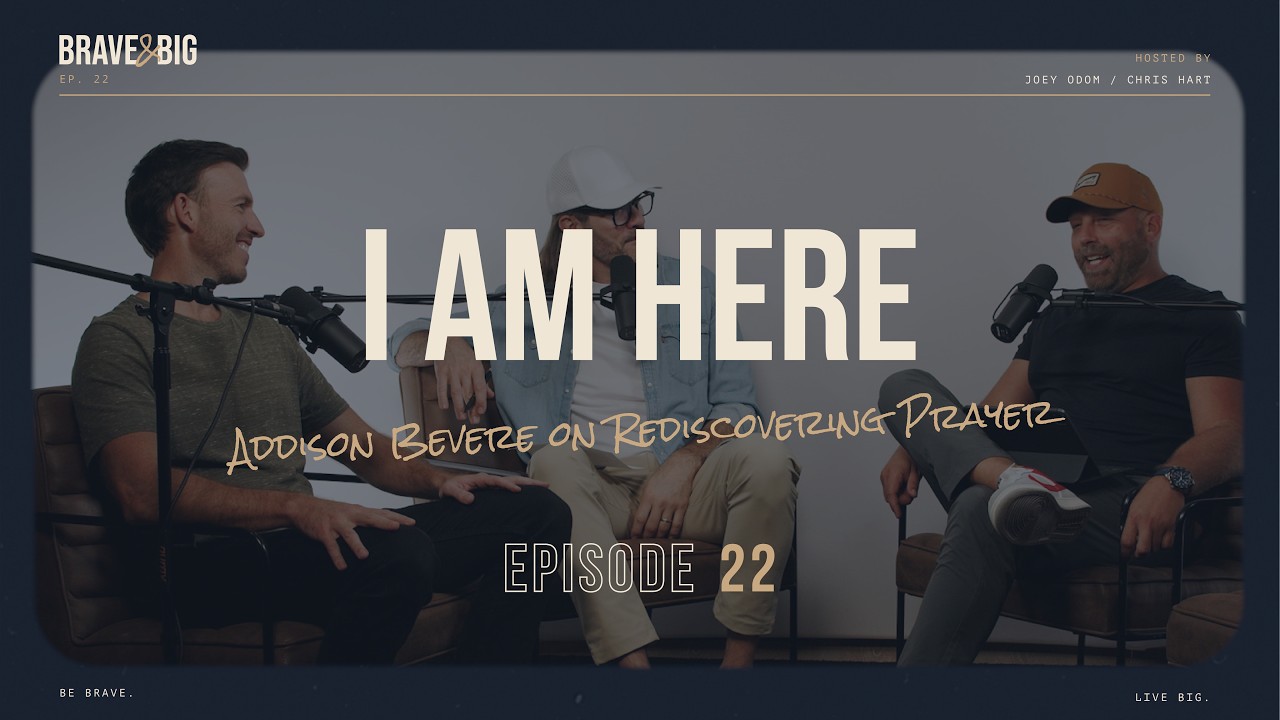
This week's small step
Answer two questions for yourself. What's your uniqueness, the thing you do that most people don't? And what's your eliteness, the thing others do that you simply do better? Then take your answers to someone you trust and ask whether they agree, or what they'd add. It's a few minutes of reflection that can change how you show up in every room.
Pastor Bill Scheer looked at a twenty-year-old Chris Hart and said something that changed the trajectory of his life: you can't make a mess I can't clean up. That's what a leader does. They take someone somewhere they couldn't get on their own.
Joey Odom and Chris open this episode with a simple reframe: start looking at every facet of your life through the lens of leadership. Not just the boardroom, but the grocery store, the sideline at your kid's game, the dinner table tonight. Because the world is looking for someone to follow, and the question isn't whether you have a title. It's whether you're worth following.
From there they get practical. Chris walks through the questions that reveal how you actually lead: what naturally flows out of you, what energizes you, what drains you, and then the two big ones, what's your uniqueness and what's your eliteness. Most people can't name theirs because it's so innate they assume everyone has it. He tells the story of a five-foot-three boat captain in Cabo who, after four hours of catching nothing, refused to go chase small fish. Then they close on the three things every leader owes the people following them: support, confidence, and hope.
In this episode
- Leadership as influence: taking people where they couldn't go alone
- Why the evidence of real leadership is trust and confidence in the people following you
- Three questions to find your lane: what flows, what energizes, what drains
- Uniqueness and eliteness, and why your superpower is the thing you assume everyone has
- On this boat, we catch Marlin: the case for refusing to chase small fish
- Position vs. posture, and why leaders out front are the ones who take the hit
- If you're not in your lane yet, be great where you are and watch where it leads
- Support, confidence, hope: how to infuse courage, because good leaders build leaders
- Why presence becomes a leader's superpower in the age of AI
- The elevation shift: driveway, rooftop, helicopter, 30,000 feet
REFERENCED IN THIS EPISODE
Pastor Bill Scheer. Andy Stanley on wisdom as the recognition that everything in life is connected. Victor Wembanyama's confidence with the Spurs down 3-1 in the 2026 NBA Finals. The idea that we suffer more in imagination than in reality (commonly attributed to Seneca).
Read the full transcript57 sections
0:04Welcome to Brave and Big, where we talk about living a Brave and Big life. I'm Joey Odom, husband to Kristen, dad to Harrison Indiana, speaker, former tech co-founder and author.
0:13I'm Chris Hart, husband to Molly, dad to Blakely, Cooper, Landry, and my son Brave. I'm the CEO and founder of the Brave Group and Brave Performance Agency. Joey and I have been having these talks for 25 years, and we're better for it. We believe the same will be true for you. Enjoy this episode. Be brave and live big.
0:35Brave and big, welcome back. Heart attack. Question for you. Out of the gate, son. Who is, today we're talking leadership? Who is a great leader that you have been around?
0:48Oh, what a good question. I think sports out of the gate, that's a fun one. There's some great, like college football coaches I've had the pleasure of interacting with. Maybe the most significant leader uh in my life and my adulthood has been my pastor, Pastor Bill Shear. Uh honestly just saw me at 20 and saw potential. And this is what he said, and and I should probably factor this into our talk today, but he said, You can't make a mess, I can't clean up. And as far as a line from a leader goes, it might have changed my life the most because that was his approach. And this kind of off the cuff, but it's interesting, it probably shows his confidence in his leadership to be able to give away that kind of opportunity to a young guy that he was just getting to know. Wow. But it was enough for me to buy in, and we still go to church there a quarter century later. You know what I mean?
1:52So I well, I I think the fruit of his leadership such a good point. The fruit of his leadership is the man you are now. I I I I watched, I've told you this, but a couple years ago, I watched a documentary that was on a pastor who um who had who since has had a moral failure and had a rough go of it. But I as I was watching him, hear me out, but as I was watching the documentary about this guy in college, he reminded me a lot of you. Was that he was big personality, everybody loved him, uh came across with a little bit of arrogance type of thing, and then he went into ministry under a leader who worshiped him. The leader that he was mentored by just worshipped him. And I believe Crete never molded him into or sanded down those edges. You were mentored by Pastor Bill, who saw all your greatness and didn't worship you, but was willing to mold you and sand off the edges and let you learn, let you learn humility and let you lead well. And man, I look at that, I look with a different mentor. And I I you're taking this right way, I'm sure, but like with a different mentor, who knows what what the end result would have been. But now I see a guy who is a you, a great leader with all the greatness you have, you've always had, but with wisdom and humility. And it is a beautiful thing. And I do think so much of that is is because of Pastor Bill, the way he mentored you.
3:17Well, a lot of kind words. It it really sets up where we want to go today. So that was a great question. But that's what leaders do. I mean, that's the that's the fruit. That idea of leadership being leaders take someone where they could not go by themselves. What a fun thing. Leadership is influence. I mean, there's there's great books, there are great people that speak on this, there are leadership coaches. We we cover leadership really every day in the brave coaching curriculum with all the people that we work with in so many different facets. And leadership presents itself in so many different ways. But I'll tell you, if we could just frame it like this today, I'm just gonna start asking you to look at every single facet of your life through the lens of leadership.
4:03Hmm.
4:04It's gonna protect you, it's gonna make you go to a higher standard. I mean, if you're if you're going to Walmart, I want you walking in there thinking, I am a leader. So if someone does something inappropriate, treat it like a leader would and help fix it and make it better, not resort to that level, right? You're at your kid's soccer game, you're there as a leader. Ain't it interesting? I mean, I I've I've been under authority. Now we run businesses, I have authority. So that don't, but if if no matter what situation you find yourself in, if you're a CEO or you're on the come up, if you'll think like a leader, what would a leader do in this situation? It really does change everything.
4:44Yeah. Why do you think people don't think that way?
4:49I don't think I think a lot of people don't see themselves as in the form of leadership. Right? They just they don't they haven't processed that they haven't made that decision to think it. If it's because they don't deserve it, if it's because they don't understand how to get there, I think a lot of people have seen poor leadership and they don't want it. And then the other side of it might be a discipline issue of actually putting in the appropriate effort to be looked at as a leader. But you know, like we do a lot of times on the pod, it's like, man, here's the reality. There's hope here. If you if you think you're a great leader, there's another level for you. And if you are aspiring to, if like you're listening to this, hoping to be inspired, that can happen. And you can think, talk, walk, and start acting like a leader right now. It's your that's right. So that's kind of where we're gonna go. And and what I'll say is I firmly believe the world is looking for someone to follow. People are looking for a leader. And I know that not everybody comes across like that, but it's amazing. When you start thinking and talking and walking like a leader, it's interesting who gets in line behind you.
5:57Yeah.
5:58And so I think that's where we go with this today is knowing that what I want everyone listening to recognize is leaders have to have an edge that makes them worth following. Because people will follow. So let's give them something great to follow.
6:16Yes.
6:16Every sports team I I go talk to, every business group, I'm like, hey, would you please make it worth following you? You know what I'm saying? Like it, and we're gonna talk about position and posture, but if you have the position or title of leader, make it worthwhile. And if you don't have that title yet, carry yourself like somebody worth following. And I am telling you right now, you will be given opportunity for leadership. Yes. What I really find fascinating is all the different ways or embodiments of leadership, right? Some leaders are amazingly strategic, others are you know crazy on the administrative side of things. That you've got some leaders that are ralliers or motivators, great communicators. Others can implement systems no matter the current situation, right? So, and I'm saying that to encourage you because whatever you potentially bring to the table, I just want to ask that you bring it to the table.
7:18Yeah.
7:19But it's really cool to kind of start recognizing that and seeing that. And a lot of times your past experiences can speak to that. Um, but I want to give you kind of some indicators on that. And it's cool too, because there's combinations of it. You know, there's times where I've had to be more administrative, it's not my favorite thing, but that was necessary in a role. There's other times where I get to really flow as a rallier and a motivator. I love doing that, right? But but sometimes different components are needed, and it's really cool to bring that to the table. Just in general, Joe, we start talking leadership. What what part of this gets you excited?
7:57Well, what excites me about that is I think when you start you can start seeing the evidence, because everything you just described, you do you described administrative or a rallier or maybe a visionary leader or something like that. But I believe the evidence of that is trust and confidence. The people who are following you, they are filled with trust or confidence. Like, oh, okay, okay, this person is gonna take us. This is the visionary leader that's gonna get everybody excited. Man, this is someone I can go follow, or this is somebody, or this is somebody administratively, like, oh, they're gonna make sure that man, we never miss a thing. Nothing slips through the cracks because they're so on top of it, or whatever that may be. But I think you can begin seeing the evidence. Now, this is different from somebody, and we can all sniff this out pretty quickly when they're just leading, they're leading because they the person want to lead. So that's not worth following, right? So there that doesn't fill with trust and confidence. That probably fills with some level of suspicion, or it burns out quickly when you realize that there's not really that they're not actually instilling trust and confidence because they're actually not leading with something, something worth being followed. So the thing I like about that is maybe that as an indicator is are you instilling trust in the people who you're leading? Are you instilling confidence in the people who you're leading? Because that's the kind of thing I believe that if you can start seeing that, you can begin to double down on those things that is instilling the trust and confidence.
9:23Heck yeah. Well, let's get real practical first. Okay, I'm gonna tell you a couple stories today. But number one, uh, I think it's really cool to evaluate yourself and just think about this. In my leadership, like when you do take a role of leadership, what naturally flows? And that's it, that's a good way to start saying it's like, you know, like if I'm gonna get up and it's like, hey, art, man, lead this team meeting, I'm gonna bend towards getting people motivated, reminding them of the why. I want to beat our chest a little bit and go run through a wall. Like that's that's what flows, like it or not. That's that's typically what I would naturally bring to the table. And it's good to realize that. So somebody that needs what I have knows how to access it, right? But but then it answers the questions like what energizes you as you lead, right? This is what naturally flows, this is what gets me excited. Man, I love seeing consistent progress on a team. Oh, I love it. That's why I enjoy coaching every single week. My aim is that we took some ground that week. I'm telling you, I'm gonna have a great dinner with my family tonight because that happened three times on coaching calls today. We made progress. I love that. But then the third question is very interesting. I want you to ask yourself, what drains me in leadership? Great thing to know. If I have to get bogged down in details and I I can do it, I can focus on some numbers, I can, but man, I'm telling you, you want to just wear me out today? Let's just talk about a whole bunch of small details and not get to interact with people and and go take a hill, right? That would drain me. So it's good to realize those things, and and there's there's two other questions I think are fun to ask, and you got to chime in on this. It's great to ask yourself, and it's great to ask other people two things. Number one, what is your uniqueness? What do you uniquely do that most other people don't? And then the second one is what's your eliteness? Oh, these are so fun, right? Like it, I know some guys and like uniquely that they are they are so uniquely creative in how they approach things. I I I've not if they're looking at a problem, they're seeing around corners, I didn't even know there was a corner. It's a unique gifting. I've seen other guys that are like unique um at how they can simplify things. Right? It it's it's uncommon. This is a complicated thing, and they have a unique ability to simplify, right? Then elite is man, other people do it, you just do it better. Huh. I've got my my friend built a monster plumbing company around here, and he his work ethic is elite. That dude, that he could do 20 calls a day, not get tired. It brings him energy, and when he's there, he works hard and fast. It is elite. Other people work hard, other people make calls. I've watched him do that, and he's got almost like like a Michael Phelps has like a crazy like lung capacity or something. He has that when it comes to work, huh? So if we can start identifying some of these things, it's really amazing. And then the question becomes, Joey, if I've identified what is my uniqueness and I've identified my eliteness, why would I do anything else?
12:52So true.
12:53Get in your lane as a leader. This is what you bring to the table. So bring it and let's quit getting distracted by things that aren't your best.
13:03Do you think that it's harder to identify either one of those? Do you think either one is more difficult to identify within yourself?
13:10Yeah, and you know what? If I'm being honest, they're probably going to overlap a little bit, you know, and I think that's okay. Maybe the uniqueness a lot of times you can say, Well, when you actually start running this exercise, you might say, Well, that might actually just be an eliteness. And I think that's okay, right? Because, you know, it's almost maybe the us not trying to be prideful of like, oh, nobody else does this, right? But but like you, Joey, I would guess one of your unique abilities is to connect with absolutely anybody. Right. That that's unique. I've I've not seen that in a lot of people, right? And then, you know, so so that's interesting to to kind of recognize and feel, and but like what I would encourage everybody is don't undervalue it, don't dismiss it, don't downplay it. I I want a world full of people that recognize what's unique and elite about them, and then that's how they fire off in their leadership.
14:09This I I believe, and you know, maybe another way to say this, people throw this term around is superpower. Is I believe I've learned this over the years that people don't actually recognize that they have a superpower because it's innate to them. And so they just assume that it's common to everyone. So when you begin to identify or explore where you're unique, where you're elite, it may actually be a little bit more challenging than you might think, because you might think that the things that you're so proficient at, which is why I like you what uh what you said, Chris, was kind of following what drains you, let's follow your energy a little bit to find out that may lead you down the path to determine this is where I'm unique, this is where I'm elite.
14:53I like that a lot. And and to your point, it's not sometimes we don't see it as that because we're just seeing that the world through our superpower all the time. That's I'm just assuming everybody's very organized. Does everybody not get excited all the time? You know what I mean? So it's a great thing to realize. And so I'll tell you this: we went to Cabo a few years ago, and I accidentally drugged Molly. Uh she was worried about a little bit of seasickness. I gave her a couple of pills, um, and then I read the box afterwards, and they're like, You're supposed to break the pills. So I just gave her a couple more. Okay. And so now she's four deep, and she doesn't remember any of this amazing story. But um she was asleep on the boat, like weekend of Bernie's. It was awesome. But we're out there, we've been on the water for four hours and hadn't caught anything. We saw a few Marlin, me and me and the other couple, me and my friend and his wife, because my wife was asleep. But we we saw some and didn't catch a thing. So I took it upon myself to go talk to the captain and just have a great conversation because I was a little frustrated without catching anything, right? I go up top, he speaks Spanish, and I just said, Hey sir, we're not catching anything. Why don't you take us somewhere else and we'll just catch a bunch of little fish? That'd be great. It'd be more fun to catch some fish than not catch any fish. And Joey, this guy looked at me so resolute, and he's five foot three, and like stood up straight, stared me in the eyes, and he said, On this boat, we catch Marlin. And it was strong. And I thought, today we don't, you know what I mean? Like, that was my idea. That'd be like the last four hours, yeah. But he was so resolute on what he did. Like, this is what he brings to the table. And it was funny, like, we got off the boat and we gave him a tip. We didn't catch a thing, we had like another hour left. It it never it the story doesn't get better, we just didn't catch anything. But I'm for real, like we're walking back to the taxi, and I was like, that guy knows what he does.
16:58Uh huh.
16:59And even though that day wasn't perfect or ideal, he wasn't gonna bend on what he did well and go do something for for a like a cheap, immediate gratification of small fish. We catch Marlin on this boat. I'm sorry it's not perfect today, but that's who I am, and that's what we do. And I really think if we'll get like that, like let's understand what we're great at. What's unique about your leadership? What's elite about it? What drains you? Let's not do that, right? That'd be like going and getting those other little fish. Man, what are you great at? And if you'll consistently bring that, I'm telling you, the world's gonna get your best, and your following is gonna grow and you're gonna accomplish what's in your heart.
17:43Man, imagine if everybody had that resoluteness that that Marlin boat captain had. What if we all had, and again, we we we're so easy that it's so easy to look at where somebody else is great. And again, this is probably a little bit of the downside of maybe undervaluing. I'm so glad you cautioned against undervaluing your superpower, your eliteness, your uniqueness. Because what can easily happen is we just start wishing that we had somebody else's uniqueness and eliteness, and then we don't walk around. The world is deprived of what we have to offer that situation. So just think about that, bro. Like, think about if if you had a group around you where everybody was so comfortable in theirs. So, what happens is you eliminate comparison, you eliminate one, you know, uh envy, you eliminate all the stuff, but you know, backstabbing and pride and all that stuff, just recognizing I got a superpower, they have a superpower, and man, together, if we're all walking in those, we're absolutely unstoppable.
18:44A great quote from the book, Green Lights, speaks to that, Joey. The great man is not all to each, he is each to all. The genius can do anything, but does one thing at a time. I'm not walking around trying to be 10 different iterations of leadership, but I can be what I'm good at to each individual that I have the opportunity to lead. And and even though, man, there's a lot of talented people that are listening to this, and it's like you could do a lot of stuff, but let's let's do the next thing, let's do it at our absolute best ability and capability, and and watch the fruit really increase because there's a laser focus to the type of leadership that we operate in.
19:32I I'm curious for you, Chris, along those lines, is that your I believe that your eliteness is pretty apparent to anybody who meets you pretty quickly, like listener, being around Chris, you're gonna get the juice out of the gate. So, how especially with that, where where that eliteness or uniqueness is on display, or maybe even even just as a leader in general, how do you cultivate this within a team? How do you how can you cultivate within everybody that comfort to really fully operate in those superpowers, the uniqueness of that eliteness? Um, how do you make sure a team is doing this? Because that's got to be a to me that again, there are things to get done, but then even it's just like drawing that out of people and making them feel comfortable doing it themselves. How do you begin to cultivate that within a team?
20:16Great question. Uh, number one, your team is going to emulate your actions, right? We talked about phone use, like kids are gonna mimic what they see their parents do. Exact same thing. If your team sees you effectively in your lane and in your strength of leadership, I really believe they're gonna feel empowered to walk in that themselves. Okay, that's good. And then I'm I'm gonna actually steal from our alignment episode. We talked about a couple things that are really good for a team to think about, and and I'll I'll use it here. But this would be a great for you as a leader, think about these questions for your team. Is number one, that does everybody know what their strength is? Right? There's plenty of personality tests. I think honestly, a lot of times, if you'll have a conversation, like next time you do a team lunch, just make everybody look at the other person and say, what is Carl great at? What's Becky great at? What does Susan bring to this team and to this table? It might be that simple because, and especially if you ask three people, if I ask three people what Joey brings, there's gonna be a real theme to that, and you're gonna be very confident to walk like that. So, one, make sure that your team knows what their strength is. And then number two, with that strength, are you clear on your lane to run in? Because what happens is we we we have, you know, you as the leader, then you've got kind of your under shepherds and and different, you know, department heads and stuff like that, which is great. But let's all make sure we know what we're specifically supposed to be leading. What's the actual expectation? What's the fruit that's being looked for? And man, I really think if we're clear on that, it's gonna be great. And then the third thing is simply if you know your strength and you know your lane, are you taking ownership? Leadership's ownership. And and really the better word for it's probably stewardship, right? So you're leading something, you're stewarding that opportunity. I'm I'm stewarding, I'm leading my kids, but I'm stewarding them. Those are God's kids. I'm stewarding the brave group. I want it to be the best it can possibly be. I've submitted it to God, but you better believe I'm leading like a steward every single day. I wake up because I own it. And I want it to be the best it can be. And and and I really think there's something there on leaders that that don't just let something stay where it is. If you're leading, it should be advancing.
22:55Here's what's cool about that too, is that this this may sound a little bit counterintuitive, but if you find yourself right now listening and you wish you had a leader who was asking those questions, maybe you're maybe you're not you don't have the title of a leader, but you're a subordinate. Here's what's cool. Here's what I believe is that if you say, Oh, I'm not in my lane right now, or I'm if I'm in I'm in a lane that's not my superpower, here's what's cool. If you are great with whatever lane you're in, you will very soon find yourself promoted into your superpower. That's a word, I believe. Yes. But it begins with, we've said it before, what's in my hand? Am I being great with what's in my lane right now? Because pretty soon you'll find yourself in your strengths.
23:37Oh, that's good. Yeah, and and and I like that. That that's ownership. You got if you're if you feel like it's the perfect position or not, can you still own it? Yeah, that's actual submission. And then if we're gonna go spiritual here for a minute, the level of your submission is gonna activate the level of your authority.
23:57Come on.
23:57Right. So it's like, man, I'm um, if you are the CEO, great. You better make sure you're submitted to God on that thing and and watch that company grow. If you're a department head, man, are you some if you completely agree with everything or not? Can you be submitted? Can you can you give it the ownership that's needed uh because you you're living a submitted lifestyle, man, when it comes to that job? So I think that's pretty cool. And then keep this in mind leaders are out front. And that is that is real sexy until bullets start flying, right? Right. It's almost like I love traveling the world until you've been on a 10-hour layover in Beijing, and it's like traveling the world's not that. It's like, man, I want to be a leader, right? I'd right and and we we love the platform, but boy, the the process is all there. And so here's the trick leadership means you're out front, which means you're gonna take the hit. And that's why we can't be isolated leaders, that's why we can't be lone wolves on this thing. That's why our our our position's one thing, but our posture is the other thing. Yeah, and we've touched on posture a little bit, but that's that's the reality of leadership is man, is your posture right to where you're receiving from God, getting strengthened, actually walking in authority, not just your title. People confuse leadership for a title sometimes. It's like, man, I need you taking people somewhere, not just hiding behind a title. And I think to really take them somewhere, you've actually got to walk in authority, which means I'm receiving, so I'm getting strengthened so I can take the hit. And then the other posture is there's that posture of attacking. Let's go get it, let's meet the objective, let's go meet the quota. I was on a call with a with a leadership team yesterday, and and as of right now, they have until the middle of next week to meet the quota for the year, and they're three million off. And I and they're like, hey, we are not exactly sure how this could possibly happen, but we are absolutely convinced it's going to happen. And guess where that's coming from? The leader.
26:07Yeah, yeah. Right.
26:08I mean, I got to talk to the the leadership team and the leader of that team, and to the person, to the man, and to the woman, every one of them are like, I'm not exactly sure how, but it will happen. Oh my gosh. I mean, and it's because that leader dug in and said, Hey, I'm gonna take the hit, we're gonna go, we're gonna go take the seal. Let's walk in authority, and it's gonna be fun to come back and report that they did it. Yeah, but that was a decision made by an out front leader.
26:36Yeah, I I you know this. I'm no Victor Wembanyama fan, I'm no Wemby fan, but when they when they were down 3-1 to the Knicks, he said something and he got so much grief for it. He said that they said, Do you still think you have a chance? And he said, Everyone in that locker room knows we're gonna win this championship. They didn't, by the way, but I I thought it was so interesting that he got so much grief for it. And I thought to myself, like, why would you not? Like, why would you not go believe? Why would you not go down swinging? Why would you not think something is why would you not think something is is terminal or fatal? Why would you not keep going? And I just I was I was shocked by that, that people were so surprised at him looking and thinking, like, yeah, I'm gonna lead with confidence, we're gonna give it everything we have. So it's it's interesting to your point of taking the hit. And we we said this before on just like you're gonna have some haters when you have vision. You are gonna have some haters, but you got to think like, no, this is the type of person because we can Luke Collins gave me this quote that I love, and it's it's that we suffer more in imagination than reality. So think about that team you mentioned. You could either let's say next week they don't achieve the that three million dollars. Let's say they don't get it within the next week. Well, at least they didn't suffer leading up to it. At least they believe. So you could either fail twice or you can fail once. So let's give it everything we have and be willing to take some hits in the meantime.
28:03Well, and I think that leads to if you're a leader, I don't care what else is a part of your culture, there has to be this culture that we infuse courage. At the end of the day, and and I, you know, it's fun on your third grade soccer team. Man, if I'm coaching those little girls up, I'm infusing courage. I'm I'm yeah, hey, we both don't like Wimby, but I'm saying some Wimby stuff. You know, I'm saying it's like, hey, we're not good at soccer and we're down 05, but I think we can win, girls. Let's go. Should I say like let's let's go hit somebody at least, right? But same thing, man. I I gotta go hit quota, I gotta go provide for my family, I've got to discipline my kid. Like, let's so let's infuse some courage. And so I think it's cool that word we we talk about a lot, but encouragement is to infuse courage. And I'll I'll give you three things that have really stood out. If we're gonna be good at this, if we're gonna encourage the people that are following us, number one, they have to feel your support.
29:08Yeah.
29:09And that's easy to say, and that's almost even soft, but I'm gonna define it as you're gonna listen and you're gonna be present. And if people that are following us, and and think about this personally, this for sure makes sense in your family, but you better believe it makes sense in that boardroom or on that insurance sales floor, right? Like if you as a leader will listen to what they're actually saying, to what they actually need from you, it's amazing how our ability to infuse courage goes up and our leadership gains so much equity. Okay, number one, support. Number two, we give people confidence. Confident people can do the impossible. And if you're if you're a leader, I'm telling you, this is this is the stuff. Recognize what your people are doing well and let them know that you see it. That's how we give confidence. Yes. I saw you do the I saw you make your calls. I know that's not crazy. I saw you doing it, I think you're good at it. I can even help you be better at it, but I see you doing it. And then remind them what they're gifted to do. Right? Because here's what's great. As leaders, we're not building followers. Good leaders are building leaders.
30:30Man, that's good right there.
30:32So I need the guys that are on our team, I want them full of confidence, knowing what they're great at, because that's what they bring to the table as a current leader and future leader. Give people confidence. And then number three, we give hope. Man, if you're a leader, we're casting vision for where they're headed and we're showing them what's possible. Now it's a man, that guy will run through a wall for you. I told him he could. I let him know he's capable of it. I reminded him of what he's good at so he's confident. And it's like, man, this is where we can go. Let's get like man, all of a sudden, people are doing what everybody else said they couldn't do because they didn't have a leader that believed in them. You see this on Teams all the time. You know, like a Tom Brady comes to the bucks and that locker room goes up. They believe in him because he believed in himself, and then he started pointing out some of the things that they were great at. Here's what each of you bring to the table. And then as a result of his strength, if you like Tom or not, it's shocking what happened when that individual, a leader, came into that locker room and the result was a Super Bowl.
31:49Yeah. I I there's I think there's especially in the give confidence, I think there's a real risk that it may feel like you're taking in giving encouragement. I think I think a lot of people may work counter like, no, no, no, I gotta keep them, I gotta keep them free, I gotta keep them on their toes, I gotta keep them wanting more. I just don't subscribe to that. I subscribe to the give confidence. I subscribe to pointing out what someone's doing well and just trusting that means they're gonna double down on it. It's just when was the last time you heard something specific that you do that you didn't want to do more of it? You know what I mean? Was the last time your spouse said something to you about something you like? You thought, well, I gotta do that really well next time. I want to keep doing that well. It's to me the great risk here in, and again, I think some people hear this and they they think, oh, maybe it's a little, you know, confidence and hope. And I've I really think you can take this risk because I have seen it again and again and again. You've seen it again and again and again. This these are multipliers for people, these are not things that are gonna make them feel lazy or rest on their laurels. No, they're just gonna want to continue to double down, particularly you have the right people on the team, because those people on the team are gonna want to do it more and more.
33:01And that's it.
33:03What about a fourth one? Of just, you know, feel support, give confidence, give hope. What about a fourth one just calling them big dog?
33:09Oh, bro. Statistics will show you get a 30% increase in output if you just and if you and also if you're kind of like big dog, you know, I mean you put a little stuff on it, yeah. Oh, son. That's how we should have started. Yeah, big dog. Could have been a shirt, whatever. Just just big dog them and move on.
33:28Hey, I will tell you the one thing under the field support, that that idea of presence, I'm I have a working theory that that leadership superpower of presence is gonna become more and more and more valuable as AI becomes more and more and more prevalent. Because the the one thing that AI can never be is a human. It can never actually be fully embodied with the spirit, like it can't be like in right in front of you. And so I think like the best leaders we're gonna find, because listen, the smartest person, the smartest one in a room for the rest of history will never be a human. It's always gonna be AI. So you're never gonna be the smartest in a room, but you can be the most present. And what happens here, I think of everything you just laid out, what you're really doing by being present and listening and giving confidence, giving hope, what you're doing is you're filling up a bank account for that person. Because one day you're gonna have to make a hard decision together. One day you're gonna say, Hey, we're gonna pivot and I need you to trust me. And all you're doing is drawing down on that bank account that you built up over years. And so I think this is why it's so important is that you're building, because when you're present, you're saying, hey, I care about you. You matter to me, and that's the type of person that somebody's going to follow. And so you're filling up, just think of it, think about it, even if you don't see the results, just know it's a small little deposit in a bank account that you're probably gonna need someday.
34:55Oh, I love that. And you know what the reality is? I bet there's three of those a day. You know what I mean? It's it's hard. But somebody needs, I think about it with my kids all the time. I mean, Brave wanted to play dominoes the other day, and I'm like, oh, I'd like you never tell me the last thing I want to do today. But but if I look at it through the lens of leadership, I'm leading my son, I can be present, and I can actually add equity to his tank by saying yes to that 10-minute game. Equity, leadership building moment, much less taking a guy to lunch before the board meeting, just saying, What actually would help you the most? What's the outcome you're looking for? It works at every level. And you know, that's an interesting point on levels. You think about just the term elevation. Different leaders are at different kinds of levels, right? So but think about if I walk outside of my house, I can look around and I can I can see four or five driveways, and that's my perspective. But if I'm gonna elevate as a leader, if I get up on top of my house, I can see a couple streets, I can see 20 houses, you know what I mean? If I get in a helicopter, oh, I can see the neighborhood, I can see the surrounding neighborhoods, you know what I'm saying? I can see my favorite restaurant, and then if I get on a plane at 30,000 feet, it's a bunch of little squares. Man, and so maybe the call out here is let's get maybe realistic with where your current elevation is. And and then I would I would ask you to start thinking at maybe the next level. That doesn't mean you're gonna get the authority for it just yet. You might not get the responsibility for it just yet. But if if you're like, man, I'm I'm I'm just kind of working hard, great. Why don't you just think about what would a leader at the house view be seeing, be thinking, be saying? What would that next level look and sound like? And and this is a little bit of a hack. I think if you'll start kind of talking like that, leading like that, I got a feeling that guy's seeing some things that maybe you weren't seeing, which is why some decisions were made. I mean, there's a better way, there's a better outlet, there's a better way forward, right? But we're actually giving some time and space to think about it. But if we'll be late leaders that are willing to kind of come above what's what everybody else, the excuses that this level makes, that's not the who you are. You're thinking at this level, leader, and I got a feeling you're going to be given that opportunity.
37:33And I love the idea of a 30,000-foot leader every now and then popping down down to the ground to see, okay, let's see what perspective do they have. What am I not seeing? This this is where wisdom, Andy Stanley, I believe, has the best definition of wisdom. He says wisdom is the recognition that everything in life is connected. So if you can then see how the organization works from the perspective of the ground level person and then the and then the the top of the roof, and then the helicopter person to get a more holistic picture, that will inform that 30,000-foot decision that the organization follows.
38:07I'll say this. We'll we'll put a little bow on it. There's a whole lot to unpack on leadership.
38:13Yeah.
38:14If I could just practice what we're preaching here for a second and infuse courage, I just want to, if you're listening to this, there are people that need to follow you. There, there are people that are counting on you to set a tone and a precedent. And I really want to challenge you to think of yourself like that and really operate from that place. If you are already, in the eyes of a lot of people, a leader, I just want to encourage you. There's another level for you. There might be getting a coach, it might be a mentor, it might be tuning in with your pastor a little bit, it might be grabbing your closest friends that sharpen you and just saying, I think there's another level. But I really, this is a topic that's near and dear just because the world needs better leaders.
39:01Yeah.
39:01We we work with politicians, we work with some of the highest level people. They get to lead their states and countries, and it's fascinating because even at their level, it's like, man, how can I be better because the people deserve it? And if you're like, man, I'm I've got this, I've got this role at Taco Bell, and and great, be great in that role, but there's people that want to follow you. And so it really is almost like a cry, but let's make it more like a battle cry. Uh we we can change the, we can literally, this is how we change the world, is by each of us individually becoming better leaders, putting a premium on it. And again, what's in our hand? What people do we currently, what's our current sphere look like? And if we're a better leader for that sphere, we're gonna take them somewhere they're currently not, and it's gonna be better for everybody.
39:55I think about on a super practical level, you and I are about to finish up this podcast, and I'm gonna go and have dinner with Kristen and Gianna. And I have an opportunity. What about how am I gonna show up in that moment? And and it's funny thinking through the lens of if I view myself as a leader, I can completely change that moment. Everything, this could be the best dinner we ever have, and it's about, but it be it, it starts with identity, Chris. It starts with recognizing no, I'm a leader in this moment, and I can lead this moment well. So, so maybe along those lines for for doing what we do every week, which is we leadership is we could probably have four or five parts to a leadership series here. But if we want to think about what's that, what's that one small step? And we're thinking next seven days, what can somebody do? What's that small step they can take to lead a brave and big life when it comes to leadership?
40:55I'm gonna ask you to legitimately answer the question, what's your eliteness and what's your uniqueness? It's good. If you'll start there, it's gonna give a path forward. And so what I would say is over the next seven days, answer those questions for yourself and then ask somebody you trust. Might be your spouse, might be your best friend, somebody you work with. Do they agree and align with? Is there anything they would add to what you've identified as your uniqueness to eliteness? And if you'll do that, that's gonna be really good. That's gonna be a really cool seven days. Yeah, but that's also gonna give you a trajectory of how to operate, how to communicate, what to focus on, and now you know what to bring as you're looking at every aspect of your life as a leader.
41:43That's that's the step, that's the small step. This will take a few minutes for reflection, and it could change the way you show up in every room. And I believe this is what we want for ourselves as well, for you, for your families, for your kids, is for you to make those small steps, take the small steps that will help you be brave and live big. Okay, real quick, triple S for us. Subscribe, share, star, give us five stars wherever you listen to podcasts. Thank you so much for joining us this week on Brave and Big. Brave and Big is produced by Stonest Podcast and the brilliant Miles Hall Britain. We will see you next week.